iPhone and Apple Watch · iOS 26 · Coming to the App Store

Feel it.
Before you say it.

Timeout learns your body's own signs that you are leaving the window of tolerance, taps your wrist, and walks you through a real 20-minute break. So you get to choose your words.

Everything on device · No audio stored · Free for 14 days, then 99 NOK a month

Apple Watch Ultra 3 in black with Timeout on the screen

Sound familiar?

It happens fast.
And always a little too late.

01

You said something you regret. You knew it while you said it.

02

You noticed you were angry only afterwards. By then it was too late.

03

You went quiet. It was read as not caring.

04

You saw it coming. And walked straight into it anyway.

That? Now you get a head start.

Your body speaks before your head does. Timeout listens, and gives you the seconds you need to choose.

How it works

Body first. Words after.

1

The window is open

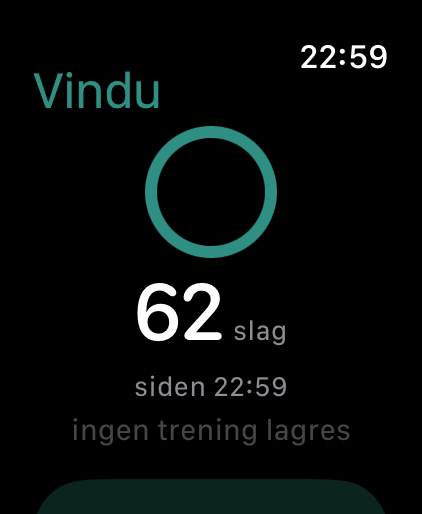
Your watch reads your pulse every second, all day, without saving a workout. Your phone listens for body sounds when you are at home: sighs, gasps, a raised voice. Never words. Start a workout and Timeout steps aside, then opens again afterwards.

Apple Watch Window
62
bpm · since 07:40
At home, quiet evening. Mic on.
Normal window today. Slept 7 h 20 min.

no workout saved · orange dot on the phone

2

The window is closing

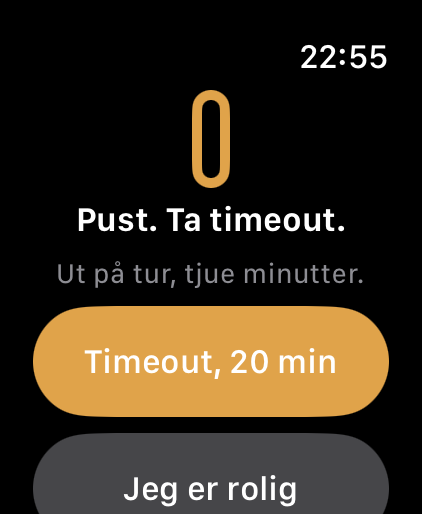
When your pulse climbs while you sit still, or your body sighs the way it does before your own episodes, you get two soft taps on the wrist. One line on the screen. Two buttons. No lecture, and nobody else notices.

Apple Watch Level 1

“The window is closing.”

81 bpm · +17 over expected, at rest
Two sighs in the last three minutes
TimeoutOk
3

Timeout, 20 minutes

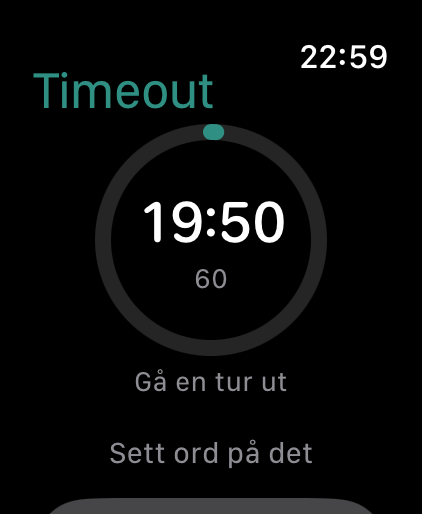
Gottman found that the body needs at least 20 minutes before it can take in new social information. The ring counts down, the suggestions fit where you are, and the watch tells you when your body is calm. Afterwards: one card with sentences that repair.

Apple Watch Timeout
19:20
Go for a walk outside
Good. You chose the break. That is what counts.
Your body is calm. The window is open again.
Can we start over?
4

Put it into words

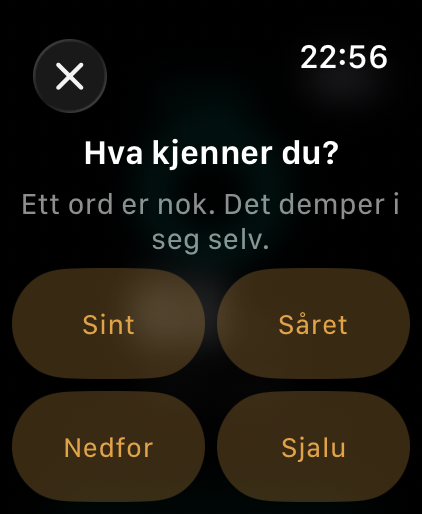
Afterwards the watch asks: What do you feel? One word is enough. Naming the feeling calms it, and gives the app a label with your body in the same moment. That is how the model becomes yours, not a generic stress app.

Apple Watch Afterwards

What do you feel?

AngryHurtDownJealousSadCalm

one tap · stored with pulse and deviation

How it feels

An evening at home.
Minute by minute.

TimeoutSaturday
18:10The window has been open since morning. Pulse 62. Phone on the kitchen counter, orange dot.
19:40Conversation at the table. Two sighs in three minutes. Your pulse goes from 64 to 81 while you sit.
19:40Two soft taps. “The window is closing.” Nobody else notices. This is early.
19:41You choose Timeout. The watch praises the choice, not the result. Your phone shows the ring on the lock screen.
20:01Your pulse is down. The window is open again. The card: “Can we start over?”
20:02“What did you feel?” Hurt. One word. Done.

none of this left the phone · no audio · no words · no cloud

The research

Not a stress app.
Gottman on your wrist.

Everything the app does has a place in the literature. Here is what matters most, with sources. Where the books are precise, the app follows. Where they are not, we do not guess.

01

Flooding starts long before you notice it.

Gottman and Levenson call it diffuse physiological arousal. Around 100 beats a minute you lose humour, empathy and the ability to listen. You repeat yourself, and sight and hearing narrow. The threshold is lower for the very fit. That is why Timeout learns your curve, not a fixed number.

Gottman, What Predicts Divorce (1994) · Levenson and Gottman, J Pers Soc Psychol (1983, 1985)

02

The body needs 20 minutes.

The stress hormones have to clear before the brain can take in new social information. Reading something unrelated lowered the pulse in the experiments. Rehearsing the argument did not. The break should not last longer than 24 hours, or it becomes avoidance. So the break has a ring, and a reminder the next day.

Gottman, The Seven Principles for Making Marriage Work · The Man's Guide to Women

03

Stonewalling is usually flooding. Not indifference.

Eighty-five percent of stonewallers in Gottman's studies are men, and men notice flooding later. So body first: pulse and body sounds, not “did you realise you were angry”. Timeout has its own variant for silence and stillness with a high pulse.

Gottman, The Seven Principles for Making Marriage Work · The Man's Guide to Women

04

The window of tolerance.

Siegel describes the zone where you can think and feel at the same time. Outside it wait fight, flight or freeze. Porges shows how the vagal brake keeps you inside, and how it lets go. The app's vocabulary is his: the window is open, the window is closing.

Siegel, The Developing Mind (1999) · Porges, Psychophysiology (1995)

05

Naming the feeling calms it.

Lieberman showed that affect labelling lowers activity in the amygdala. One word is enough. That is why the watch asks “What do you feel?” after the break, and why the answer is one tap, not a diary.

Lieberman et al., Putting feelings into words, Psychological Science (2007)

06

Sighs are a signal.

Vlemincx found that sigh rate rises under mental load and discomfort. So Timeout counts sighs as density over minutes, not as single events, and only when the pulse agrees.

Vlemincx et al., Psychophysiology (2011, 2015)

07

The voice gives away the arousal before the words.

Juslin and Laukka showed that pitch, loudness and tempo carry emotion across languages. StressSense showed it can be measured on a phone. Timeout measures the deviation from your own calm voice, and never listens for words.

Juslin and Laukka, Psychological Bulletin (2003) · Lu et al., StressSense, UbiComp (2012)

08

The repair attempt decides.

Whether the attempt is received matters more than what is said. It is the clearest line between couples who last and couples who do not. The card after the break gives you the sentences, not the case.

Gottman, The Seven Principles for Making Marriage Work · A Couple's Guide to Communication

09

Sleep shrinks the window.

Without sleep the prefrontal cortex loses its grip on the amygdala, and reactions get stronger. So Timeout reads sleep, HRV and resting heart rate from Health every morning, and knows how wide the window is today.

Yoo, Walker et al., Current Biology (2007) · Thayer and Lane, neurovisceral integration (2000, 2009)

10

The right help, in the right second.

Nahum-Shani shows that help works when it lands in the moment, and evaporates otherwise. Fogg shows that the celebration in the second after the choice is what turns it into a habit. So the alert is short, and the praise comes when you choose the break, not when you finish it.

Nahum-Shani et al., Annals of Behavioral Medicine (2018) · Fogg, Tiny Habits (2019)

The books behind it

  • The Seven Principles for Making Marriage Work
  • The Man's Guide to Women
  • A Couple's Guide to Communication
  • Ten Lessons to Transform Your Marriage
  • What Predicts Divorce?
  • The Developing Mind
  • Tiny Habits
All sources, with links
  1. Gottman, J. M. (1994). What Predicts Divorce? Lawrence Erlbaum. Gottman Institute on self-soothing
  2. Levenson, R. W. and Gottman, J. M. (1983). Marital interaction: physiological linkage and affective exchange. J Pers Soc Psychol 45
  3. Levenson, R. W. and Gottman, J. M. (1985). Physiological and affective predictors of change in relationship satisfaction. J Pers Soc Psychol 49
  4. Siegel, D. J. (1999). The Developing Mind. Guilford. Summary of the window of tolerance
  5. Porges, S. W. (1995). Orienting in a defensive world: a polyvagal theory. Psychophysiology 32
  6. Thayer, J. F. and Lane, R. D. (2000, 2009). Neurovisceral integration. Overview
  7. Yoo, S.-S. et al. (2007). The human emotional brain without sleep. Current Biology 17
  8. Gjoreski, M. et al. (2017). Monitoring stress with a wrist device using context. J Biomed Inform 73
  9. Schmidt, P. et al. (2018). Introducing WESAD. Personal versus general models
  10. Adams, R. P. and MacKay, D. J. C. (2007). Bayesian online changepoint detection. Physiological application
  11. Juslin, P. N. and Laukka, P. (2003). Communication of emotions in vocal expression and music performance. Psychol Bull 129
  12. Lu, H. et al. (2012). StressSense. UbiComp
  13. Vlemincx, E. et al. (2011). Sigh rate and respiratory variability during mental load. Psychophysiology
  14. Vlemincx, E. et al. (2015). Emotion, sighing, and respiratory variability. Psychophysiology
  15. Sheppes, G., Scheibe, S., Suri, G. and Gross, J. J. (2011). Emotion-regulation choice. Psychol Sci 22
  16. Lieberman, M. D. et al. (2007). Putting feelings into words. Psychol Sci 18
  17. Nahum-Shani, I. et al. (2018). Just-in-Time Adaptive Interventions in mobile health. Ann Behav Med 52
  18. Fogg, B. J. (2019). Tiny Habits. On celebration
  19. Apple (2024). Using Apple Watch to measure heart rate, calorimetry, and activity
  20. Apple Watch, HRV and resting heart rate, validation. PMC · Living review of accuracy, npj Digital Medicine

The technology

Pulse every second.
Nothing leaves the device.

Timeout is written in Swift for iOS 26 and watchOS 26, on Apple's own frameworks for health, sound and location. No server, no account, no model in the cloud. Here is what actually happens.

1 sbetween pulse readings on the watch
20 minbreak, as in the book
8episodes before the model is yours
0audio files stored, ever

Expected pulse, not raw pulse

The watch learns what calm is for you per hour and place over the last 14 days. The signal is the deviation from that, with walking and workouts subtracted. A staircase is not an argument.

Two sentries on the deviation

CUSUM catches the slow climb. A Bayesian changepoint catches the sudden shift. Both have to speak before the watch taps.

Body sounds without words

Apple's sound classification runs on the iPhone: sighs, gasps, breathing, shouting, crying. Only the class and the time are stored. Never audio, never text, never what was said.

The voice as deviation

Pitch and loudness are measured against your own calm voice. A raised voice is a number in a curve, not a quote in a log.

New

Your own signature

Two minutes of reading and a few groans give a signature that lives only on the phone. It separates your voice from others, and your sighs from room noise.

The situation

Home, work and gym from three points you set yourself. Driving and walking from motion, in a meeting from the calendar. Mic only at home. The suggestions follow the place.

Window width today

Sleep, HRV and resting heart rate from Health say each morning how wide the window is. After a bad night the watch taps a little earlier.

Your own model

At 8 labelled episodes a model is trained on your curves, tested leave-one-out with at most one false alarm a day. Below 8 the threshold is generic, and the app says so.

New

Feelings as labels

The words you put on the feeling are stored with pulse and deviation. The map in Insight shows what your body tends to do before each word. Feelings from Mindfulness in Health are imported.

Watch and phone together

Live Activity in the Dynamic Island and on the lock screen. Complication and Smart Stack on the watch. Double Tap starts the break from the alert.

Built with

  • Swift 6
  • SwiftUI
  • SwiftData
  • HealthKit
  • SoundAnalysis
  • WatchConnectivity
  • ActivityKit
  • WidgetKit
  • CoreLocation
  • CoreMotion
  • EventKit

Privacy

This is an app about you. Only you.

01

Everything on device.

Pulse, body sounds, episodes and the model live on your watch and your phone. No account, no cloud, no server at Appit. Delete the app and it is all gone.

02

No audio stored. No transcription.

The microphone yields only classes and timestamps: a sigh, a shout, crying. No words, no buffer, no file. It runs only while the window is open, by default only at home, and never in the car or in a meeting.

03

Orange dot. Always.

When the microphone is on, the iPhone shows it. We hide nothing from you, and nothing from the people around you. The watch shows that the pulse is being measured.

04

Not an app about your partner.

No alerts to anyone else. No score on the relationship. No advice about the other person. Nothing that records children. Timeout does not judge the content of the conversation, it gives you a window to choose.

05

Honest in Health.

The pulse is measured with a workout session that is never saved as a workout. The feelings you log are written to Health only if you turn it on. Everything the app reads is in the permissions you grant.

transcriptionstoring audiocloud AI on your voicepartner alerts hidden recordingfake workoutsrelationship scoreaccount

Timeout is a tool, not treatment. It does not replace a therapist, and it makes no diagnoses. If you are struggling, talk to someone who can help.

Pricing

Try it for 14 days.
Then 99 NOK a month.

One edition. Everything included. The subscription is bought in the App Store, renews monthly, and can be cancelled any time. Those are the kroner that keep the app getting better.

The first 14 days

0 NOK

  • Everything included from day one
  • Watch and phone
  • No commitment
  • 14 days, then you decide

Cancel in the App Store before the days are up and it costs nothing.

After that

99 NOK a month

  • All features, no add-ons
  • All updates included
  • Your model, your episodes, your watch
  • Cancel any time

VAT included. Billed through Apple, charged monthly until you cancel.

No features are locked behind a pricier tier. There is only one Timeout, and you get all of it.

From the founder

I have read Gottman for years. I knew what flooding was, what 100 beats means, and that the body needs 20 minutes. It did not help. I noticed too late, every time. What I was missing was not insight. It was a head start of a few seconds.

The watch already has my pulse. The phone hears the sigh before I do. Timeout is those seconds, and the break that follows. I built it for myself first, and it is honest about what it cannot do. Now you can have it too.

Trond Klæboe Founder · Appit AS · Bergen, Norway

Try it

Try Timeout.
The first 14 days are free.

Timeout is coming to the App Store. It does what it says, it is honest about what it does not do, and it keeps getting better.

Download on the App Store

Free for 14 days, then 99 NOK a month.

iPhone with iOS 26 · Apple Watch with watchOS 26

Timeout by Appit · Bergen, Norway

Terms of service

Last updated: September 2026 · Applies to timeout.appit.ai and the Timeout app

1. Who we are

Timeout is provided by Appit AS, org. no. 933 898 210, Kokstadveien 41, 5257 Kokstad, Norway. Questions? Write to trond@appit.ai or call +47 56 32 00 00 / +47 401 88 800.

2. What the service is

Timeout is an app for iPhone and Apple Watch that measures your pulse and recognises body sounds on your device, alerts you when your body shows signs of flooding, and guides you through a break. The website provides information about the app. The app keeps developing, and features may be added.

3. Who it is for

Timeout is made for adults, and you must be at least 16 years old to use it. The app is not directed at children and we do not collect information from children. If you are afraid of someone, or of what you might do yourself, contact your local emergency number.

4. Not treatment

Timeout is a tool for self-regulation, not healthcare. It makes no diagnoses, treats no conditions, and does not replace a doctor, psychologist or therapist. Pulse readings come from Apple Watch and carry the limitations Apple describes. If you are worried about your health, contact a health professional.

5. Disclaimer

Timeout is provided “as is”. We work hard to make everything work, but cannot guarantee that alerts always arrive, or always hit. The app learns from what you label yourself, and is generic until you have labelled enough episodes.

6. Your responsibility

7. Payment and cancellation

Timeout is free for 14 days. After that it costs 99 NOK a month, VAT included. The subscription is bought and renewed through Apple's App Store, and cancelled in the settings for your Apple ID. If you cancel, the subscription runs to the end of the period you have already paid for, and does not renew. Apple's terms for App Store purchases govern payment, refunds and the right of withdrawal.

8. Intellectual property

Appit AS owns Timeout, the trademark, the code and the content on the website. The data the app collects about you is yours, and it lives on your device.

9. Limitation of liability

To the extent the law allows, Appit AS is not liable for indirect loss from use of the service, including consequences of alerts that did not arrive or arrived wrongly. Our total liability is limited to what you have paid for the service in the last 12 months.

10. Changes, governing law and venue

We may update these terms. Material changes are announced on the website or in the app. The terms are governed by Norwegian law, with Hordaland District Court as venue.

Privacy policy

Last updated: September 2026

1. Data controller

Appit AS, org. no. 933 898 210, Kokstadveien 41, 5257 Kokstad, Norway, is the controller for personal data collected through timeout.appit.ai. Contact: trond@appit.ai, tel. +47 56 32 00 00 / mobile +47 401 88 800.

2. What the website collects

Nothing. timeout.appit.ai sets no cookies and uses no tracking or analytics. Your browser remembers on its own whether you closed the language suggestion, and that never leaves your browser. If you email us, we process what you write in order to reply (legitimate interest, GDPR art. 6-1f).

3. What the Timeout app collects

As little as possible, and all of it stays on your device. The app reads pulse, resting heart rate, HRV, sleep and workouts from Health, recognises body sounds from the microphone as classes with timestamps, keeps track of whether you are at one of three places you set yourself, and tells rest apart from walking, running, cycling and driving. If you turn on calendar as context, it also sees whether a meeting with other people is going on right now. The episodes and feelings you label, and the model learned from them, are stored locally on the iPhone. No audio is stored. No text is made from what is said. Nothing is sent to Appit or to any cloud. Feelings are written to Health only if you turn that on in settings. The app requires no account. The points below take each source in turn.

4. The microphone and the body sounds

The microphone is off until you turn it on yourself, and iOS shows the orange dot the whole time it is on. It only runs while the window is open, only at home, not in a car, and not while a meeting is going on. Apple's classifier runs on the phone and gives classes such as sighing, heavy breathing, gasping, shouting, screaming and crying. Only the class, how confident it is, a coarse loudness and the timestamp are stored. The sound is gone the moment it has been analysed, and no audio file is ever written.

The microphone does not tell people apart. If others are in the room, it picks them up too, and a raised voice or crying from them can become a class with a timestamp. No words are recognised, no text is made, and no audio is stored — neither yours nor theirs. You are responsible for having the microphone on only where you are allowed to. If in doubt, leave it off.

5. Voice signature and groan templates

If you want the app to tell your voice from other people's, you can read a short text aloud for two minutes and record a few groans. The recording never becomes an audio file. It is turned into number vectors while it is being recorded — mel energies, that is, how the loudness is spread across frequency bands — and only the numbers stay. This is a local voice signature. It stays on your phone, it never leaves it, and you delete it with one tap under Settings → My voice and my sounds.

The signature is used for one thing: to decide whether a raised voice is yours, so the app does not learn from other people's. The groan templates work the same way, and let the app recognise a sound Apple's classifier has no name for.

6. Place and movement

You set three places yourself: home, work and gym. Only those three points are stored, as a position and a radius of 150 metres. The app notes that you arrived at or left one of them, not where you are otherwise. No route, no coordinates in the history, no tracking.

Movement is read from the motion data in iOS: the app tells rest apart from walking, running, cycling and driving. That is used to separate a rise in pulse at rest from one caused by walking, to word the alerts, and to keep the microphone off in a car. Only the state is stored, with a timestamp.

7. Calendar as context

Off by default. If you turn it on, the app reads the calendar — reading only, never writing — to answer one question: is a meeting going on right now that is not all-day and that has at least one other participant, and when does it end? Title, participants, location, notes and attachments are not used and not stored. The answer is used to keep the microphone off during the meeting and to adapt the suggestions. Turn the calendar off again and the app stops asking.

8. Health data

Health data is processed on your device under Apple's HealthKit rules, and only with the permissions you grant in Health. Appit has no access to it, and does not use it for marketing or any other purpose.

9. How long things stay

Raw heart rate, body sound events, place changes and motion are deleted automatically once they are older than 90 days. The episodes and feelings you label yourself, the alerts, the breaks and the learned model stay until you delete them. Everything can be deleted with one tap under Settings, Data, Delete everything.

You delete episodes one by one in the list. Under Settings → Data, “Delete everything” removes the history the app has built on the phone: pulse, alerts, timeouts, episodes, body sounds, place changes, praise, decisions, movement, capacity and sessions. The voice signature and the groan templates are deleted separately under My voice and my sounds, and the places are removed one by one under Place. If you delete the app, everything on the phone goes with it. What the app has written to Health belongs to the Health app, and you delete it there.

10. The watch and the complication

The watch app puts a small snapshot in the keychain on the watch, so the complication on the watch face can show the same thing as the app: the state of the window, the latest pulse, the score and when a running timeout ends. That is all that is kept there. The item is marked for this device only and is not synced to iCloud or to any other device.

11. Payment

The subscription is handled by Apple through the App Store. Appit does not receive your payment details, only anonymous sales figures from Apple.

12. Sharing and processors

We never sell data. The website is hosted at Vercel. Payment is handled by Apple. There are no other processors, because the app does not send data to us.

13. Your rights

You have the right of access, rectification, erasure, restriction and data portability. The data the app collects lives on your device, and you delete it yourself, see point 9. Write to trond@appit.ai with any question. You can also complain to the Norwegian Data Protection Authority (datatilsynet.no).

14. Changes

Material changes to this policy are announced on the website. The date at the top always shows the latest version.
Cookies

Last updated: September 2026

Short version: none.

timeout.appit.ai sets no cookies, and loads no tracking, no ad pixels and no analytics. So there is no banner to answer either.

The technical part

If this changes, this page is updated first.